Subscriber Retention
Part of Subscription commerce metrics
Subscriber retention versus repeat purchase
Compare continuing subscriptions with later purchases using clear cohorts, time windows and rules for skips, renewals and prepaid deliveries.
Subscriber retention asks whether a defined starting group still holds a subscription at a later date. Repeat purchase asks whether those customers made another qualifying purchase within a stated window. Use both when subscriptions and one-off products sell together; each answers a different question.
Define the two groups
For retention, name the starting cohort — say, customers whose first subscription began in a particular month. Choose a customer or contract unit: if a customer has two plans and cancels one, contract retention falls while customer retention may stay unchanged. State whether a pause counts as retained and how a prepaid plan with deliveries still due is treated.
For repeat purchase, define the first purchase, the later qualifying transaction and the time allowed. Decide whether an automatic subscription renewal counts. If it does, identify those renewals separately: a renewal order does not show that the customer returned to browse and choose another product.
For a paid-purchase measure, verify payment rather than treating every order placed as collected. Count distinct customers for the share who bought again; count orders for purchase frequency.
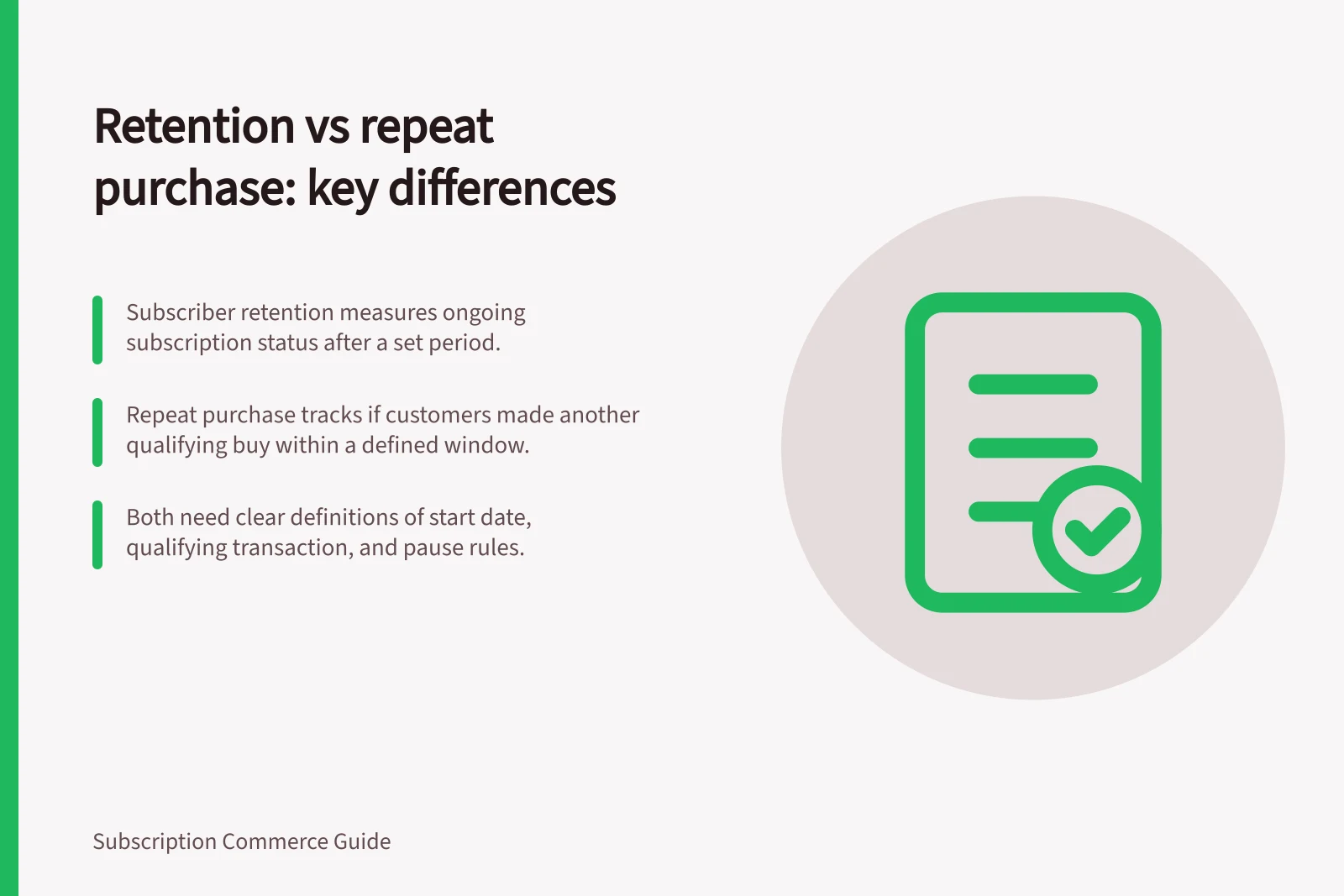
Subscriber Retention vs Repeat Purchase: Key Differences
- DefinitionMeasures whether a customer still holds a subscription at a later date.
- FocusContinuity of subscription plan over time.
- Measurement UnitCustomer or contract level (e.g., one customer with two plans may have mixed retention outcomes).
- Repeat Purchase DefinitionWhether a customer made another qualifying purchase within a set time window.
- FocusSubsequent buying behaviour, including one-off products.
- Measurement UnitDistinct customers for share; orders for frequency.
Give each plan a fair observation window
A quarterly subscriber has not missed a cycle one month after joining. Compare customers after a comparable opportunity for their next scheduled order, or show plans with different intervals separately. A prepaid plan can produce another parcel without another purchase or charge.
A purchase-based cohort view answers a different question from subscription status. Check the report’s definitions and transaction basis before comparing it with a retention measure.
Best Practices for Measuring Subscription and Purchase Behaviour
- Align observation windows with billing cyclesCompare customers after a comparable opportunity for their next scheduled order.
- Treat prepaid plans carefullyA prepaid plan can deliver another parcel without a new purchase or charge.
- Clarify pause rulesDefine whether a paused subscription counts as retained.
- Separate automatic renewalsIdentify renewals separately if assessing customer choice to buy again.
- Verify payment statusFor paid-purchase measures, confirm payment collected—not just order placed.
Interpret the measures together
Suppose a hypothetical cohort contains 100 customers with a subscription at the start of a review. At the stated later date, 75 still have an eligible subscription under the chosen pause rule: customer retention is 75%.
Suppose 60 of the same starting customers made a qualifying later purchase in the observation window: repeat purchase is 60%. These figures illustrate the definitions; they are not benchmarks. Check which customers appear in both groups.
A retained subscriber with no later purchase may have skipped, paused or not yet reached the next billing date. A repeat buyer without a current subscription may have cancelled and later bought once. Check the schedules and transactions before interpreting either pattern.
Use retention to assess continuity of the plan across cycles. Use repeat purchase to assess later buying, including one-off products when relevant. Put cohort size, dates, qualifying transaction, pause rule and exclusions beside each percentage. Keep automatic renewals visible when the question is whether customers made an additional buying choice.