
Offer Design
Part of Subscription acquisition offers
Evaluating a discounted first box by later customer value
Calculate the first-box acquisition gap and assess whether later paid subscription cycles recover it using a clearly defined cohort.
Evaluate a discounted first box by whether later contribution from acquired customers recovers the first-box gap and acquisition cost within a stated number of cycles. Count observed paid shipments separately from projected ones. First-box revenue alone cannot answer the payback question.
Calculate the first-cycle position
For each acquired subscriber, take the amount attributable to the first shipment after its discount and refunds. Subtract product, packaging, packing, delivery, payment and order-level remedy costs. Add the acquisition cost assigned to that signup. Use a consistent GST basis and state how costs are allocated.
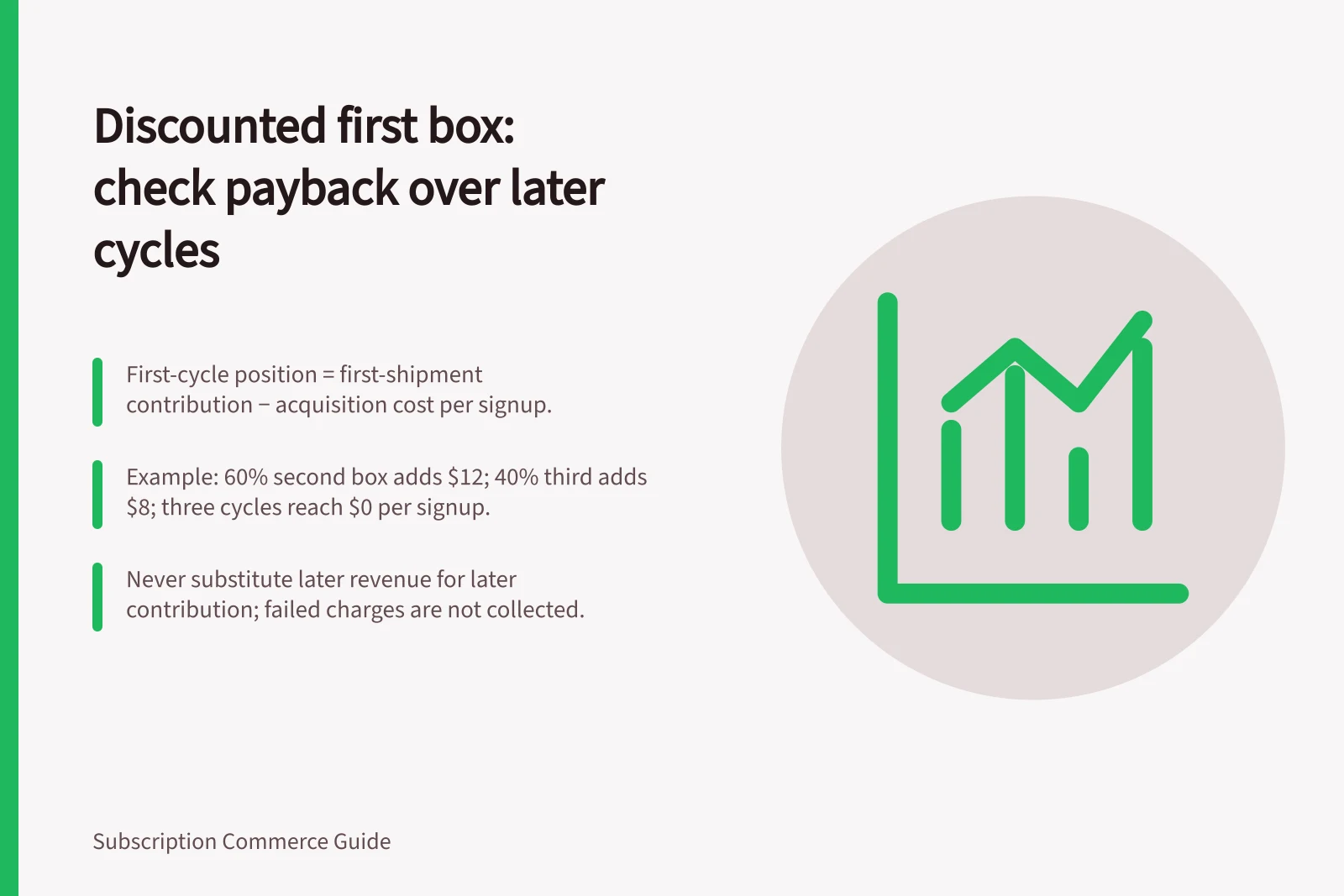
First-cycle position after acquisition = first-shipment contribution − acquisition cost per acquired customer.
A negative result is the amount later contribution must recover; it is not automatically a failed offer. For a prepaid plan, allocate the advance payment across its promised shipments under a stated method while keeping the actual payment record separate.
Follow the original signup group
Group subscribers by the offer received and first paid-order date. For each later scheduled cycle, record whether payment was collected, a parcel was supplied, a skip or pause occurred, and a refund or replacement was needed. An active contract is not proof of a paid shipment, so include later shipment contribution only when the charge and supply outcomes are known; show unresolved cases separately.
Give each plan a fair opportunity to reach the ordinary-price cycle. A quarterly group has fewer renewal opportunities than a fortnightly group after the same number of calendar weeks. Show cohort size, delivery interval, observation date and the number eligible for each later charge.
Record these outcomes for every later scheduled cycle
- Payment collected
- Parcel supplied
- Skip or pause occurred
- Refund or replacement needed
- Charge and supply outcomes not yet resolvedreport these separately
- Cohort shown with delivery interval, observation date and number eligible for that charge
Work a bounded example
Suppose a fictional first box has an $8 contribution loss and acquisition costs $12 per signup. Each later ordinary-price box contributes $20 after its own supply costs. If 60% of the original group pay for and receive a second box, that cycle contributes an average of $12 per original signup.
If 40% of the same original group pay for and receive a third, it adds $8. The three-cycle position is −$8 − $12 + $12 + $8 = $0 per original signup.
These amounts and percentages illustrate arithmetic, not retention benchmarks. Actual refunds, replacements and payment failures must be included under the chosen contribution definition. Break-even contribution over three cycles does not establish overall business profit.
Keep projections separate
Do not substitute later revenue for later contribution or count failed charge attempts as collected payments. Assign a free replacement to the affected cycle's costs rather than treating it as a new paid renewal. If the cohort has not matured, show future renewal and contribution assumptions as scenarios, then compare them with observed outcomes later.
Check the discount's actual end point in the relevant subscription system and verify how it applies to existing contracts and future billing cycles.
Set the observation horizon and contribution target before reviewing results. Compare with a suitable group where one exists, noting differences in product, channel, destination and customer mix. An observed difference does not by itself prove the discount caused it.