Fulfilment
Part of Subscription fulfilment
Creating a reliable recurring packing schedule
A recurring packing schedule should start from the customer promise and work backwards through billing, order release and carrier collection.
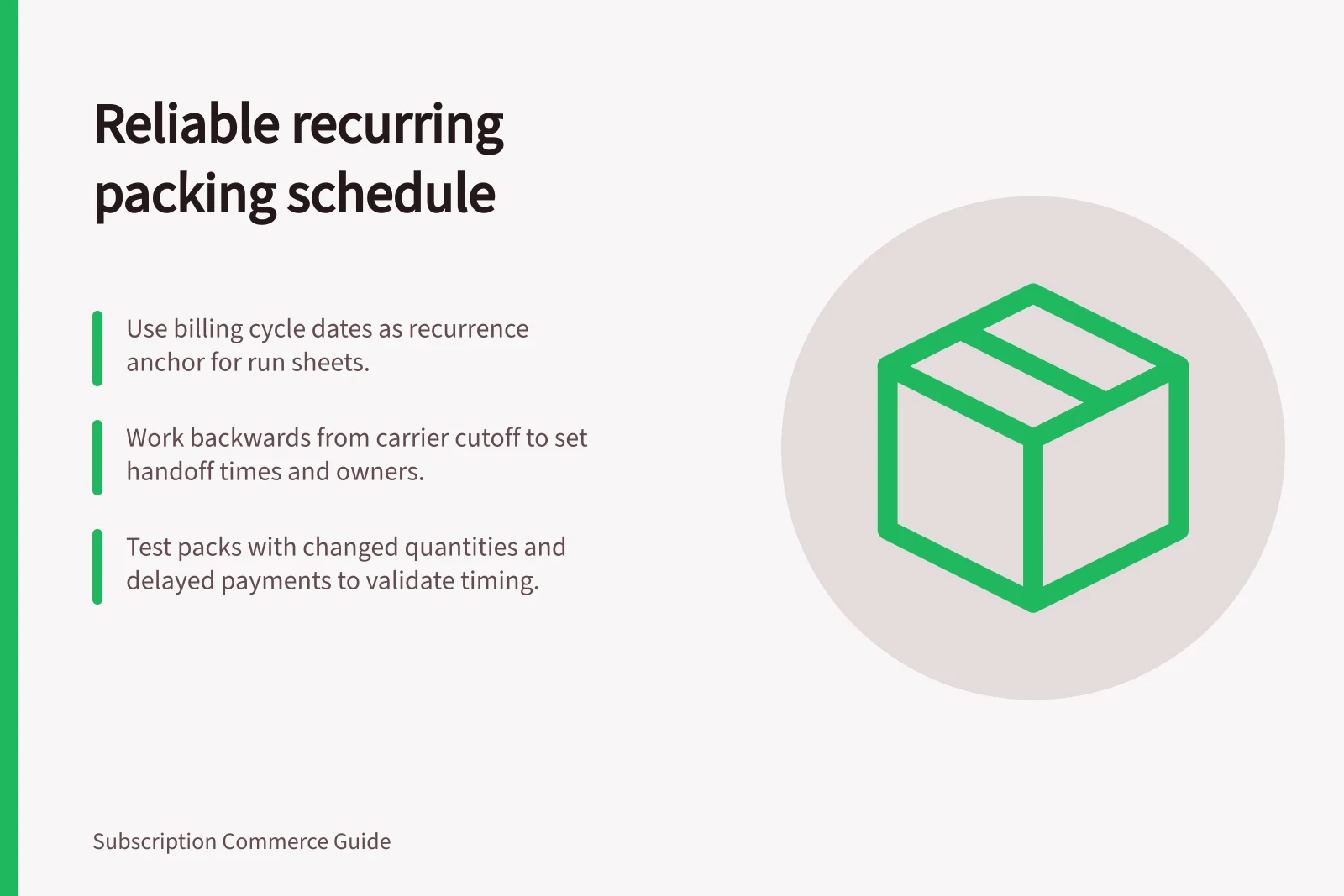
Create one dated run sheet for each subscription billing cycle. Use its scheduled billing and delivery interval as the recurrence anchor, then work backwards from the customer promise and the carrier collection or dispatch cutoff.
Enter the actual dates and times from your billing schedule and carrier cutoff. Keep the handoff sequence consistent, and adjust dates when holidays or carrier cutoffs affect the run.
Creating a Reliable Recurring Packing Schedule
- Anchor to Billing CycleUse the customer’s billing cycle and delivery interval as the recurrence anchor. Align with actual dates and times from the contract.
- Mark Key HandoffsRecord each stage: billing review, order release, picking, packing, dispatch. Include owner and completion check.
- Work Backwards from CutoffStart from carrier collection cutoff and assign actual times to each prior handoff.
- Maintain Consistent SequenceKeep handoff order fixed: payment review → order release → picking → packing → dispatch.
- Adjust for Holidays or DelaysUpdate dates if holidays or carrier cutoffs affect timing; do not rely on assumed cadences.
Mark the handoffs
A billing cycle represents one period of billing and delivery information for a subscription contract. Cycles are indexed from when the first version of the contract is initialised: the first is numbered 1, the next 2.
Use the schedule inherited from the source contract as the recurrence anchor; do not assume a universal weekly, fortnightly or monthly cadence. Billing cycles inherit default schedule and contract information from the source contract, but editing a cycle can change an upcoming order without changing the source contract. Use the current released order for the run, not a stale contract snapshot.
At the top of the run sheet, record the cycle index, billing and delivery interval, customer promise and carrier collection or dispatch cutoff. For each handoff, enter its actual date and time, an owner and a completion check.
Work backwards from the carrier cutoff, entering the actual date and time for dispatch, pack-complete, pick-complete, order release, then billing and payment review. Use measured release-to-dispatch time to inform the next run; the available timings do not establish a fixed buffer between handoffs.
Keep the handoffs in the same order every cycle: billing and payment review, order release, picking, packing, then dispatch. At payment review, follow the agreed response to failed payments; do not release an unpaid order into the batch simply because it appeared on an earlier forecast.
Test a busy cycle
Test sample orders with a skipped cycle, changed quantity and delayed payment. Check that each order is final by the release cutoff and that picking and packing receive the correct version; route address updates through the established pre-dispatch check.
Pack a representative actual item and check fit, movement, closure, label placement, packing time and condition after realistic handling. Record the pack size, cushioning and sealing method, keep compatible consumables together, and use a short visual checklist for new or casual packers.
Measure release-to-dispatch time and record exceptions by cause. If manual corrections keep happening after labels are printed, move the cutoff, improve event synchronisation or change the handoff.
Repeat the packing trial when a product, carrier, outer pack or internal protection changes.
Packing Trial Checklist for Busy Cycles
- Test skipped cycleVerify order integrity when a cycle is missed in the sequence.
- Test changed quantityConfirm correct item count is picked and packed.
- Test delayed paymentEnsure unpaid orders are not released into batch; follow agreed response protocol.
- Validate final order by release cutoffCheck that all orders are confirmed before dispatch window opens.
- Review label printing issuesIf corrections needed post-print, adjust cutoff or synchronisation process.
- Pack representative itemTest fit, closure, cushioning, label placement, and handling durability.