Inventory Planning
Part of Subscription business planning
Estimating cash needs for prepaid product commitments
Map prepaid receipts and supplier, packing and delivery payments by date to find the funding gap before promised parcels are supplied.
Estimate cash needs by payment date, including the lowest balance before expected customer receipts arrive. Prepayment moves cash forward, but the business still owes later parcels. A plan can contribute over its full term and still need funding for an earlier supplier deposit or dispatch run.
Put receipts and commitments on a calendar
List each prepaid offer sold or planned, the amount expected to clear, the promised deliveries and their timing. Keep already sold deliveries separate from hoped-for new sales. A future sign-up forecast cannot cover an invoice due before those payments arrive.
Record supplier deposit and balance dates, order-change deadlines, packaging, packing, postage, payment costs and expected refunds or remedies. Include rent, wages and tax payments that fall within the forecast. Use actual supplier terms where available and label estimates. State whether the cash figures include GST.
| Event | Possible cash in | Possible cash out | Delivery commitment to track |
|---|---|---|---|
| Supplier order | Payments already cleared | Deposit | All promised parcels |
| Customer prepayment | Payments that clear | Payment costs | Parcels still unsupplied |
| Stock receipt | Other cleared receipts | Supplier balance | Parcels still unsupplied |
| Each dispatch | Separate charges, if due | Packing and delivery | Later parcels and open remedies |
These are worksheet categories; actual supplier and payment dates depend on the agreements.
Cash Flow Timeline for Prepaid Product Commitments
- Supplier order (Deposit due)
- Week 1
- Customer prepayment (Receipt clears)
- Week 2
- Each dispatch (Packing and delivery costs)
- Ongoing, weekly
Find the funding gap
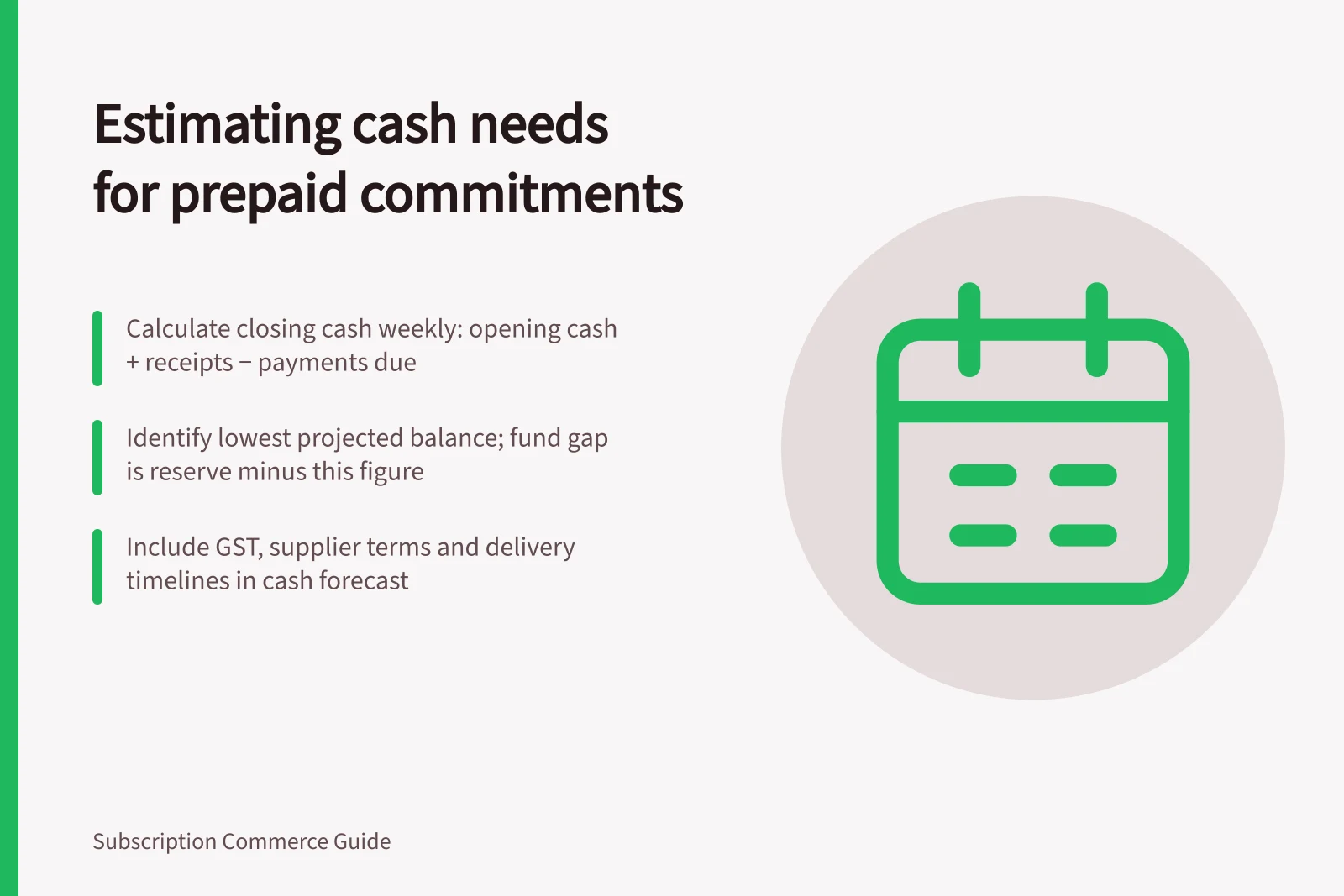
For each week, or a shorter interval near a large payment, calculate closing cash = opening cash + receipts expected to clear − payments due. Carry the closing amount forward. Find the lowest projected balance. If the business chooses a cash reserve, the additional funding needed is the greater of zero and reserve minus lowest projected balance.
In a fictional example, opening cash is $1,000 and a $3,500 supplier deposit falls due in week one. With no receipt before it, cash reaches negative $2,500.
Customer payments of $6,000 clear in week two; a later $1,000 supplier balance and $800 of fulfilment payments leave $1,700. The business needs at least $2,500 before the deposit in this simplified example, plus any chosen reserve. These invented figures exclude other bills, refunds and tax payments.
Steps to Estimate Funding Gap for Prepaid Orders
- List all prepaid offers and expected receipt dates
- Record supplier payment dates (deposit and balance)
- Include fulfilment costs (packaging, postage, refunds)
- Calculate closing cash per periodopening + receipts − payments
- Identify the lowest projected cash balance
- Determine funding needmax(0, reserve − lowest balance)
Stress the timing before accepting more orders
Move receipts later, reduce the number that clear, raise a required component cost and allow for remedies. Distinguish a deposit already paid from a future payment that can still be avoided. Ask whether the supplier permits a smaller first run or staged purchases. Do not take new prepaid orders on a supply promise the business has reason to think it cannot meet.
Reconcile this cash worksheet with a separate record of paid deliveries still due. Once a parcel is supplied, close that commitment or keep its remedy open. Cash received at sign-up does not prove future stock is secured.
Use the funding gap to decide the order size, sales capacity, reserve or financing needed. Recalculate when supplier terms, receipts or promised delivery volume change.
Pre-Order Acceptance Checklist for Cash Flow Safety
- Confirm supplier terms allow staged deliveries or smaller first runs
- Verify customer payments will clear before supplier deposits are due
- Ensure no new orders exceed available cash reserves or financing
- Reconcile committed deliveries with actual stock supplied
- Recalculate funding gap if supplier terms or sales volume change